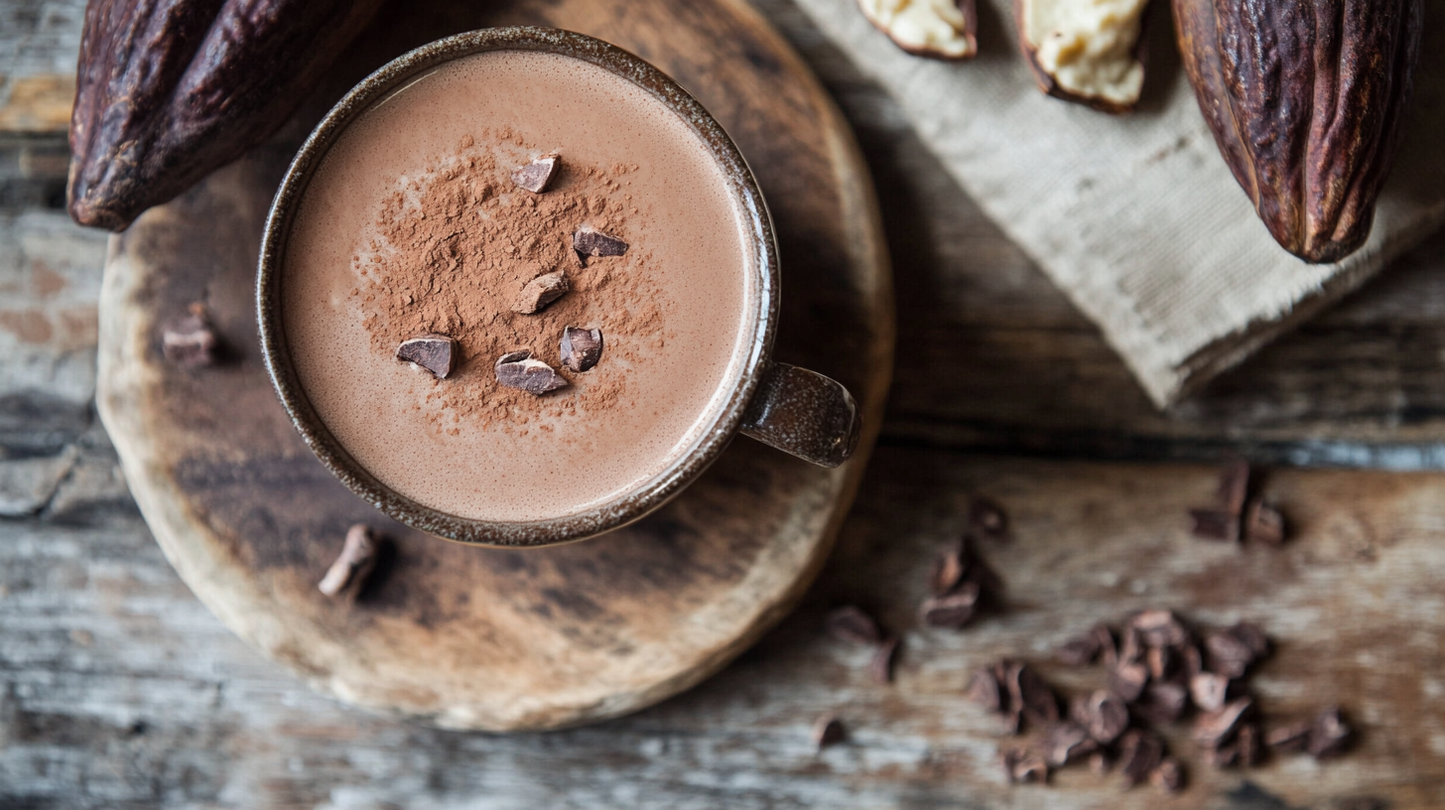
Vibrant Vitality Cacao is 100% organic ceremonial cacao with a full daily dose of maca and ashwagandha built in — 3,400 mg maca and 450 mg ashwagandha per cup. Half a pound, unsweetened, for dark chocolate lovers.
What's in it
-
Organic ceremonial cacao, regeneratively grown
-
3,400 mg maca per serving — a custom blend of red, black, and yellow varieties
-
450 mg ashwagandha per serving
No sweetener. The doses here are the point: this is not a pinch of maca for marketing purposes but a full daily amount of each, which is why the serving size matters.
The maca
Ours grows on a spring-fed family farm at 13,000 feet in the Andes. Altitude is not incidental to maca — the plant is famous precisely because it thrives where almost nothing else will, in thin air, hard frost, and intense UV. Growers hold that the stress is what makes it what it is.
We use a custom blend of red, black, and yellow maca rather than a single colour. The three are traditionally distinguished from one another and used for different purposes; blending them is the broader approach.
Why cacao as the carrier
Cacao is vasodilating and mildly cardiac-stimulating, which is the traditional reasoning for why it carries other plants well — it opens circulation and moves what is taken with it into the tissues. Mesoamerican ceremonial practice used cacao as a vehicle as much as a substance.
The plants in traditional medicine
Maca (Lepidium meyenii) is a root vegetable in the brassica family, cultivated by Andean peoples for thousands of years on the Peruvian altiplano. It has been used as staple food and as tonic, particularly in relation to stamina, endurance at altitude, and vitality across the life stages.
Ashwagandha (Withania somnifera) is one of the principal rasayana herbs of Ayurveda — the category concerned with longevity and restoration. Its Sanskrit name refers to the smell of a horse, taken to mean the strength of one. It has been used for millennia for what Ayurveda frames as building ojas, or vital reserve.
Cacao was ceremonial across Mesoamerica long before it was confection — used in ritual, marriage rites, and as currency.
The pathways: what the research examines
-
Cocoa flavanols and endothelial function. The strongest evidence base in our catalogue. Flavanols have been studied extensively in relation to nitric oxide signalling and vascular dilation — enough that European regulators permit a specific claim regarding cocoa flavanols and normal blood flow at defined intakes.
-
Theobromine. Cacao's principal alkaloid, an adenosine receptor antagonist — related to caffeine, longer and gentler in character.
-
Withanolides. Ashwagandha's characteristic compounds. Research has focused on the hypothalamic-pituitary-adrenal axis and on cortisol dynamics, with a reasonable body of human trial work by the standards of this category — though trial sizes are generally small and extract preparations differ, which limits how far conclusions travel.
-
Macamides and glucosinolates. Maca's distinctive constituents. Macamides are unique to the plant. Research is thinner than for ashwagandha, and much of it is preclinical.
-
Adaptogen, as a term, originates in mid-twentieth-century Soviet research and describes a proposed pattern of non-specific stress resistance. It is a useful frame and a contested one; it is not a regulatory or clinical category.
This describes pathways, not outcomes, and it is not a claim that this product treats any condition.
How to prepare it
Chop or shave 20 to 30 g and whisk into hot water or milk. That is the serving that delivers the full 3,400 mg maca and 450 mg ashwagandha. Add sweetener to taste, or drink unsweetened.
Most people take it in the morning. Ashwagandha suits either end of the day, but the cacao does not.
Good to know
- Half pound (8 oz) · 100% cacao, unsweetened · high flavanol
- Organic · vegan · lab tested for heavy metals
- Ashwagandha is in the nightshade family; some people prefer to avoid it on that basis
- Consult your practitioner if pregnant, nursing, managing thyroid conditions, or taking sedatives, thyroid medication, or immunosuppressants
- Contains theobromine — keep away from dogs
Common questions
How much maca and ashwagandha per cup?
3,400 mg maca and 450 mg ashwagandha in a full serving — a complete daily dose of each.
Which maca?
A custom blend of red, black, and yellow, grown at 13,000 feet on a spring-fed Andean family farm.
Does it taste like ashwagandha?
Ashwagandha is bitter on its own, but at 450 mg in a cup of dark cacao it reads as earthiness rather than as itself.
Morning or evening?
Morning. The cacao is stimulating even if the ashwagandha is not.
Is it sweetened?
No. Add what you like.
Can I use it as a coffee replacement?
Yes, and many do. Theobromine gives a steadier lift than caffeine.
Further reading
These statements have not been evaluated by the Food and Drug Administration. This product is not intended to diagnose, treat, cure, or prevent any disease.